
Vercel officially admits it has no mainland nodes, Netlify is blocked by the GFW with no solution, and AWS doesn't work for indie developers — let's do the math.
1. You've probably been through this
You spent three days building a Next.js content site. Vercel one-click deploy, smooth CI/CD, preview domain generated in seconds — looking great.
Then you send the link to a friend in China, and they reply: can't open it.
You assume it's a network issue and tell them to try again. Still won't open.
What Vercel itself wrote in its Knowledge Base:
"Vercel does not have servers or CDN nodes in mainland China and cannot guarantee availability or performance within mainland China."
You can't win that argument either.
It's 2026 — where should a domestic indie developer's site actually go? This post does the math for you.
2. What's really going on with overseas platforms
Vercel: it simply didn't put nodes in mainland China
Many people think "Vercel is slow in China" is an optimization problem you can fix by tweaking the CNAME. It really isn't.
The *.vercel.app default domain gets DNS poisoning by the GFW and times out directly. A custom domain via the official CNAME (cname-china.vercel-dns.com) can bypass it, with latency dropping to 50-100ms — but the official stance is "no guarantee of stability".
There's a community open-source project enhanced-FaaS-in-China with a CNAME relay scheme that can push latency down to 30-80ms (itdog reference values, subject to real measurement). Sounds okay? The cost: relay IPs refresh every 40 minutes; China Unicom, Telecom and Mobile behave differently; a few nodes stay blocked; when it breaks you have to debug ISP routes + IP refresh + backup DNS all at once.
Honestly, this scheme is fine for fun, not for production.
Also, Vercel's Hobby (free) plan explicitly bans commercial use — it's in the ToS. Commercial products require Pro at $20/month, about ¥145.
To be fair, Vercel's DX is genuinely good — zero-config SSR, preview deployments, Edge Functions are nearly unbeatable overseas. The only problem: its goodness has nothing to do with domestic users.
Netlify: even its staff say "there's no official solution"
Netlify is more direct than Vercel. There's a thread in its official community updated from 2019 to 2026, with 26+ replies, all asking the same question: "Chinese users are blocked — what do we do?"
A Netlify staffer's reply:
"There is no official solution for a nation blocking access."
Translated: give up.
Without optimization, Netlify traffic backhauls through Hong Kong or Singapore, with typical domestic TTFB of 200-500ms (reference values). A third party, 21YunBox, offers an ICP proxy scheme claiming 3-4 weeks to complete filing, at extra cost — I can't vouch for its stability.
AWS Amplify: usable, but not for you
AWS's situation in China is the trickiest. CloudFront does have 4 mainland nodes (Beijing, Shanghai, Zhongwei, Shenzhen), the best by pure latency.
The problem: indie developers basically can't get through. Enterprise qualification, a separate China-region account system, Cognito unavailable in China, Lambda@Edge unavailable too — you have to clear one gate after another before your project runs. By the time you're done, you could have shipped three CloudBase projects.
AWS Amplify China is an enterprise option. For indie developers, it's genuinely not worth it.
3. Do the math
| Dimension | Vercel Hobby | Vercel Pro | Netlify | CloudBase Personal |
|---|---|---|---|---|
| Monthly cost | ¥0 (no commercial) | ~¥145 | ¥0 (limited) | ¥19.9 |
| Domestic CDN | ❌ no nodes | ❌ no nodes | ❌ no nodes | ✅ Tencent Cloud CDN |
| Typical domestic TTFB | 200-400ms | 200-400ms | 200-500ms | 26-28ms |
| ICP filing support | ❌ none | ❌ none | ❌ none | ✅ file via environment |
| WeChat ecosystem integration | ⚠️ needs adaptation | ⚠️ needs adaptation | ⚠️ needs adaptation | ✅ native SDK |
| AI-native development | ⚠️ community plugins | ⚠️ community plugins | ⚠️ community plugins | ✅ MCP + Skills + 20+ IDEs |
| Commercial license | ❌ banned | ✅ | ✅ | ✅ |
TTFB data source: itdog/boce nationwide speed tests, typical reference values, subject to real measurement. CloudBase uses Tencent Cloud CDN with 2,300+ mainland acceleration nodes (source: Tencent Cloud CDN product page).
Start with money. Commercial projects require Vercel Pro at ¥145/month; CloudBase Personal is ¥19.9/month — a ¥125/month gap, ¥1,500 more a year. You're paying ¥145 for a platform with no mainland nodes, no filing, and extra hurdles for WeChat Pay — decide for yourself what that ¥125 buys.
The CNAME relay scheme's time cost is also significant. Every failure means debugging ISP routes, whether the relay IP refreshed, whether to switch nodes, whether DNS cache expired. A few dozen minutes each time, twice a month is an hour or two. CloudBase, once configured, needs no maintenance — it's Tencent Cloud CDN at 26-28ms TTFB, and that time difference adds up over a year.
The risk is even clearer. A custom domain without ICP in mainland China is running naked — it works today, could be blocked tomorrow, with no appeal channel. ICP filing requires the server to be physically in mainland China; Vercel and Netlify's servers aren't, so you can't file — a physical constraint.
On CloudBase's side, a key capability landed at the end of March 2026: a CloudBase environment can now serve directly as the filing cloud resource (changelog). Personal plan or above, environment validity over 6 months, fixed IP enabled — you can pull the environment in the filing console and go through the ICP process. No more buying a separate lightweight server as a filing anchor; that extra cost is gone.
4. Does your tech stack run on CloudBase?
CloudBase currently has several deployment modes for different scenarios:
Static website hosting — pure static sites like React, Vue, Vite, Hexo just push and you're done, CDN acceleration auto-configured. The most effortless path.
Cloud functions + HTTP access service — Next.js SSG (next export) goes through static hosting; SSR and API Routes need cloud functions. Configuration complexity is noticeably higher than Vercel's zero-config — weigh how heavy your SSR dependency really is before migrating, don't jump in with a "let's just migrate" mindset. Nuxt.js is the same.
Cloud Run — projects needing long connections, WebSocket, or custom runtimes (like Python/Go backends) go through the container mode, with multi-language support. Since January 2026 it supports single-instance multi-concurrency and WebSocket real-time communication.
Astro: not explicitly listed in official docs, but Astro outputs static HTML/CSS/JS by default, so static hosting should be theoretically compatible. Test before deciding; don't go to production on theory alone.
Frankly, if your project heavily depends on Next.js SSR, Vercel's zero-config experience is something CloudBase can't currently match. CloudBase can run SSR via cloud functions, but the config barrier is higher and the docs aren't as hand-holding as Vercel's. That tradeoff is yours to weigh.
WeChat Pay: both sides need manual work, but CloudBase has one less pitfall
Integrating WeChat Pay V3 isn't easy anywhere. On Vercel the trouble is more specific: serverless functions are stateless, short-lived containers that can't persist files, while WeChat Pay V3 needs a local .pem certificate file that also rotates every 7 days.
You can stuff the cert into env vars or use Vercel Edge Config — but that's already beyond "copy-paste and it runs", costing 2-4 extra hours of adaptation, plus Edge Runtime compatibility issues with payment callback signature verification.
On CloudBase, WeChat Pay still requires you to handle certificate storage and verification yourself — no one-click solution yet. But CloudBase's cloud functions and Cloud Run can run persistent processes, so the certificate-persistence problem at least doesn't exist. Also, CloudBase's Integration Center is coming, and once live it will support automatic payment-callback verification and decryption, further reducing that layer's dev work.
Right now both sides require manual work, but Vercel has an extra layer of runtime-constraint pitfalls.
A 2026 variable: AI-native development
Many people may not have noticed this. CloudBase's positioning in 2026 has shifted from a "cloud development platform" to an "AI-native backend platform", shipping three things:
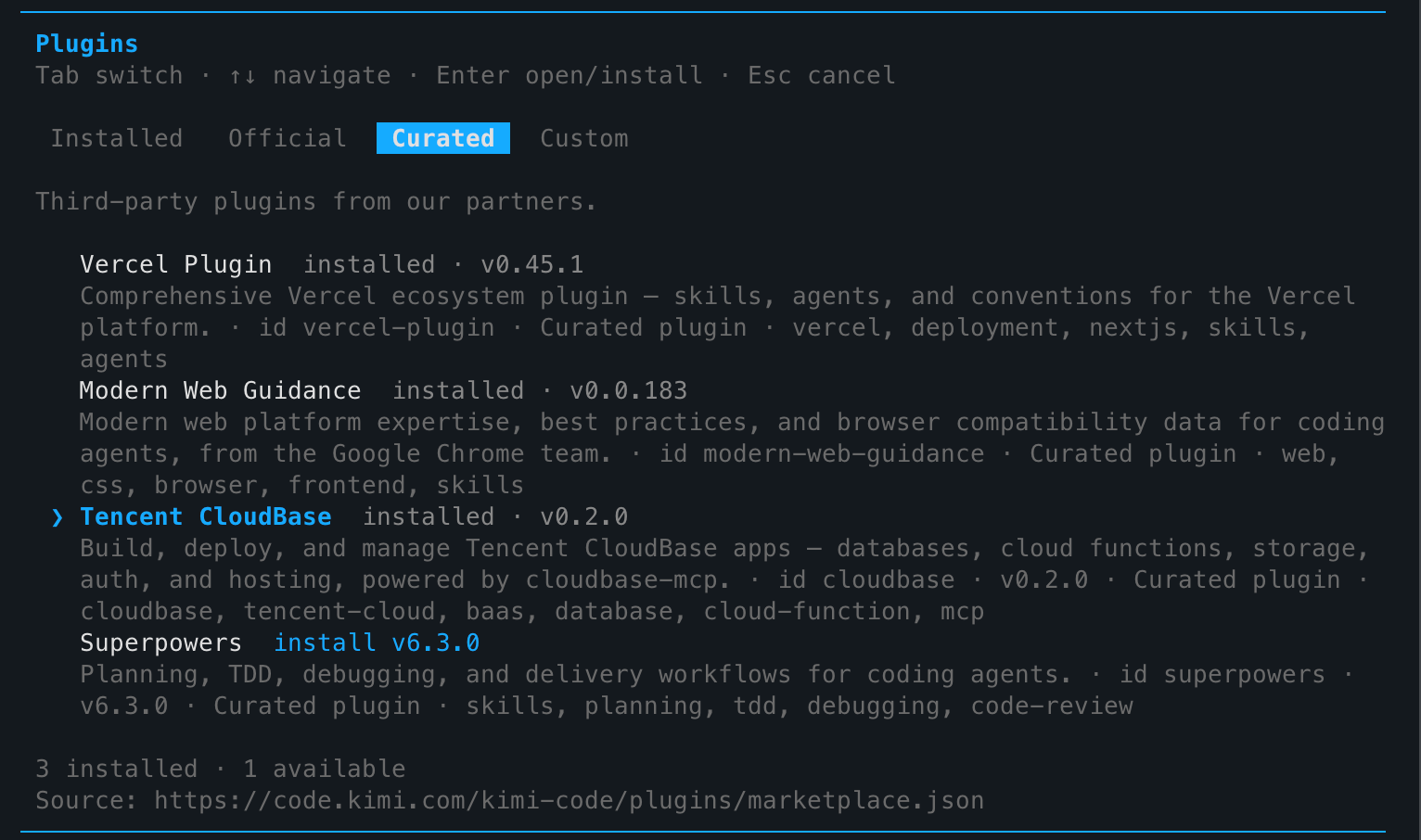
- CloudBase MCP — once installed, the AI assistant directly operates your CloudBase resources: create databases, deploy functions, change storage rules, done in one sentence
- CloudBase Skills — install via
npx skills add tencentcloudbase/cloudbase-skills, and AI understands CloudBase's capabilities without you reading docs. MCP handles connection and permissions, Skills handle norms and intuition — AI gets both power and discipline - 20+ AI dev tool integrations — Cursor, Claude Code, WindSurf, CodeBuddy, VSCode Copilot, Cline, Trae, Tongyi Lingma, Wenxin Quick Code, RooCode, Augment Code, Gemini CLI, OpenAI Codex CLI, Qwen Code, OpenCode, Kiro, WeChat DevTools… basically all mainstream AI tools are integrated
Vercel relies mainly on community plugins and v0 for AI coding — no native MCP support from the official side. CloudBase builds MCP and Skills directly into the platform — if you write code with AI now, that difference is real.
5. This math isn't hard
If your users are mainly domestic, my advice is blunt: don't let tool preference hijack business judgment. Vercel's engineering experience is genuinely good, but it has said itself it prepared nothing for mainland users — that's just the fact.
¥19.9/month, Tencent Cloud CDN acceleration, 26-28ms TTFB, native WeChat ecosystem support, commercial license, and ICP filing directly via your environment now (Personal+ with 6 months validity + fixed IP) — no extra server needed.
Static sites and SPAs can migrate today. Next.js SSG just needs a build-command change and a push. Heavy SSR users, inventory your needs first. If you write code with AI, install CloudBase MCP and Skills and create an environment + deploy in one sentence.
CloudBase Personal includes 3,000 resource points/month (since 2026-01-16); CDN traffic, cloud function calls and other quotas are on the official pricing page, with pay-as-you-go beyond quota.
Waiting until users tell you "your site won't open" only costs more to migrate.